


During the manufacturing process of cosmetics, quality control is subject to extremely rigorous standards. Consequently, ensuring high product quality hinges primarily on the purification workshops maintained by cosmetic manufacturers. This is particularly critical given that cosmetics are rich in various microorganisms; therefore, effectively purifying air quality and controlling microbial contamination during production is of paramount importance. But how much does the average person actually know about the purification workshops found in cosmetic manufacturing facilities? It is safe to assume that most people have only a limited understanding.
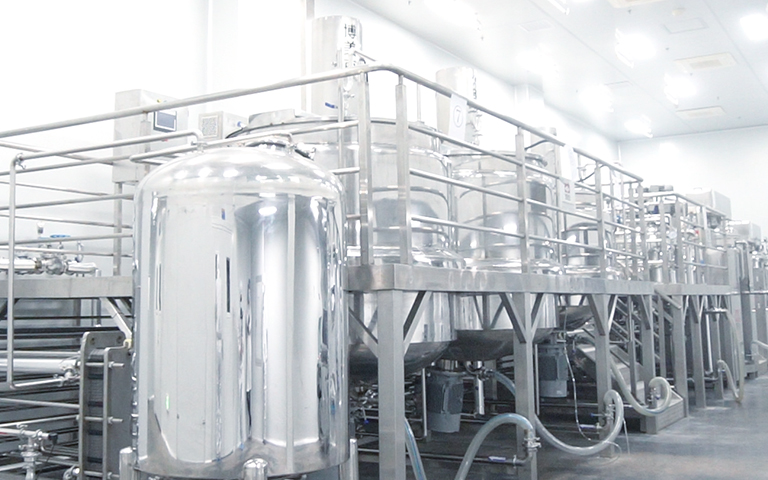
How are the equipment and parameters within a purification workshop configured?
Below, the cosmetic manufacturer will join you in exploring these pertinent questions.
First, what are the specific requirements for the production areas within a cosmetic manufacturer's purification workshop?
1. The basic facilities of a cosmetic manufacturer's purification workshop consist of the following components: a raw materials room, a preparation room, a semi-finished products storage room, a filling room, a packaging room, a container cleaning and sterilization area, a warehouse, an inspection laboratory, a changing room, a buffer zone, offices, and other ancillary areas.
2. The combined floor area of the preparation, filling, and packaging rooms must not be less than 100 square meters; the floor area per capita must not be less than 4 square meters; and the net ceiling height of the workshop must not be less than 2.5 meters.
3. The flooring of the production workshop must be smooth, wear-resistant, non-slip, non-toxic, and impermeable to water, while also being easy to clean and disinfect. The height of the waterproof layer on the walls must not be less than 1.5 meters.
4. All production equipment, tools, containers, and work surfaces within the cosmetic manufacturer's purification workshop must be thoroughly cleaned and disinfected both before and after use.
5. The production zone of a cosmetic manufacturer's purification workshop must include a dedicated changing room. This room must be equipped with changing facilities—such as lockers and shoe racks—and must also provide running water for hand-washing, along with hand-sanitizing facilities.
6. In production workshops utilizing air purification systems, the air intake vents must be positioned at a sufficient distance from the air exhaust vents. Furthermore, the air intake vents must be located at a height of no less than 2 meters above the floor, and there must be no potential sources of contamination situated in their immediate vicinity.
7. If ultraviolet (UV) sterilization is employed, the intensity of the UV sterilization lamps must be no less than 70 microwatts per square centimeter. These lamps should be installed at a density of 30 watts per 10 square meters of floor area and suspended at a height of 2.0 meters above the floor.
8. In the production zone of a cosmetic purification workshop, the total bacterial count in the air must not exceed 1,000 colony-forming units (CFU) per cubic meter.
Secondly, we need to clarify the definition of "purification" and understand the various classification grades associated with it. Definition of Purification
Within a specific spatial area, purification involves the removal of airborne contaminants—such as particulates, harmful gases, and bacteria—through specialized physical, optical, chemical, and mechanical processes. Simultaneously, it maintains indoor parameters—including temperature, cleanliness, pressure, airflow velocity and distribution, noise and vibration levels, lighting, and static electricity—within a specified range of requirements.
How to select the Appropriate Purification Class?
Cleanliness Classification:
In the context of purification, "cleanliness" refers to the number of dust particles—specifically those measuring 0.5 μm and 5 μm—present per cubic meter of air. According to international standards, comparative measurements for particles of 0.3 μm and 3 μm are also typically conducted.
Consequently, the purification class is determined by the particle count: the lower the numerical value, the higher the classification level. When ranked from highest to lowest, the standard classification levels typically include Class 10, Class 1,000, Class 10,000, Class 100,000, and Class 300,000.